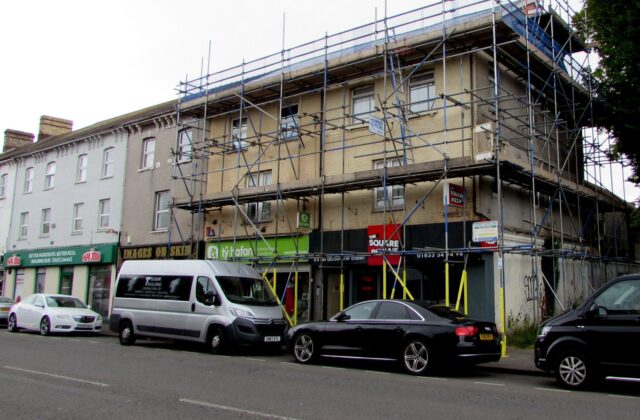

Stop, make the job safe, and don’t go back up until someone competent has decided it’s fit to use. That’s the short version. Rain by itself doesn’t always end a day on a scaffold, but when the weather starts putting people at risk, carrying on isn’t really a choice, however tight the programme looks.
What the law actually says
There’s no single rainfall or wind figure that sends everyone home. The Work at Height Regulations 2005 say that employers must make sure work at height is only carried out when the weather doesn’t jeopardise the health or safety of the people involved. That’s a judgement, which means someone on site has to make it and be willing to stand by it.
The one figure HSE does give is for roof work. Its work at height guidance says to avoid roofs in rain, ice, frost, strong or gusting wind or slippery conditions, and notes that winds above 23mph (Force 5) can affect your balance. It’s a useful yardstick, but it isn’t a licence to carry on working at 22mph in a downpour.
What usually ends the day:
- Boards too wet or slippery to walk safely, especially with materials being carried.
- Gusts making it hard to handle tube, boards or sheeting. A long tube turns into a sail at height.
- Lightning. Nobody should be standing on a steel structure in a storm.
- Visibility low enough that the gang can’t see each other or what’s below.
- Water affecting the ground under the base plates.
Site rules: stopping properly
Getting rained off isn’t the same as just getting in the van. In the ten minutes before you leave:
- Tell the supervisor, and agree who’s making the call to stop. Don’t leave it to a quiet word in the cabin.
- Clear loose materials. Anything that could be lifted by the wind should be taken down or secured. That includes boards that aren’t fixed and spare fittings.
- If the scaffold is part-built, make it safe and close it off. The regulations require warning signs and physical barriers to stop access to the danger zone whenever a scaffold isn’t available for use.
- Take off or secure the ground-level ladder. An empty site on a wet afternoon is exactly when you can’t assume nobody will climb it.
- Agree how you’ll hear about tomorrow. A message at 6am is better than a wasted drive.
Before going back up
This part isn’t optional. HSE says scaffolds have to be inspected after conditions likely to cause deterioration, including adverse weather, in addition to the usual inspection every seven days. So after a proper blow or a soaking, a competent person checks it before anyone uses it. They’ll be looking at ties, bracing, boards, sheeting, and whether the ground under the base plates has softened or washed out.
If you’re a site manager, build that into the restart. Waiting for the inspection is part of the delay, and your trades should know it. If you’re a homeowner with a scaffold on a domestic job, ask your builder whether it’s been checked after any bad weather. It’s a perfectly fair question.
The pay question
This is where tempers fray, so it’s worth being clear about what’s known and what depends on your own paperwork. None of this is legal advice.
If you’re an employee, GOV.UK says you should get your full pay during a lay-off or short-time working unless your contract allows for unpaid or reduced-pay lay-offs. So the contract is the first place to look. If you’re laid off unpaid, you may be entitled to statutory guarantee pay. At the time of writing, that’s up to £41 a day for up to 5 days in any 3-month period, a maximum of £205. You must have been employed for at least a month and be available for work, and you can’t turn down reasonable alternative work. If you do any work at all on a given day, you can’t claim for it.
If you’re on a collective agreement, such as the CIJC Working Rule Agreement, the terms apply where they’ve been incorporated into your contract. Ask your employer whether yours includes them and what they say about bad weather and guaranteed minimum earnings. Don’t rely on what someone in the cabin told you.
If you’re self-employed or on a day rate, check what you agreed before the job started. Rules that protect employees generally won’t help you, so it’s worth getting a clear line in writing on weather days.
If you’re not sure which you are, ask. Your tax arrangements don’t necessarily settle your employment status. Acas or an adviser can help.
For firms: reduce the arguments
Set out your weather policy at induction: who decides, what happens with pay, whether alternative work could be offered, and how people will be told. On bigger commercial projects, get a weather allowance into the programme so stopping for safety doesn’t feel like failure to the supervisor who has to call it.
And if you’ve got the rest of the day?
You’ve been up since five, you’re soaked, and it’s only half past ten. First, get dry, eat something, and do the jobs you’ve been ignoring: invoices, van tidying, tools cleaned and oiled. Then give yourself a break, because you won’t get many in a wet week.
If gaming is your escape, the write-up on Arcade Punks about a collector’s retro games room, complete with a Sega Blast City cabinet and around 20 TVs, might give you ideas (or a bad case of envy). Film fans have got a wet afternoon’s reading on Rise of the Footsoldier, an unofficial fan site for the film series, covering the films, cast and real-life story behind them, with quizzes thrown in. And if you’ve been meaning to try Usenet, NZB Grab is a Windows Usenet downloader that works with your own Usenet provider account.
Keep an eye on the forecast, though, because it might all change by tomorrow. If you need a hand planning scaffolding around the weather on your next job, we’re happy to talk.